At the start of the covid-19 pandemic, the majority of Finance Directors were still operating lean functions or were even one or two heads down. Factor in the extra pressures due to the pandemic and it’s no surprise that many teams are stressed and overwhelmed. We invited an expert panel to join us in a live webinar on Creating Resilient Teams. For those of you who missed it the first time around it’s now available to watch in full.
https://youtu.be/hrf5y3VVo3Q
Our guest speakers at creating resilient teams
Stewart Robertson, co-founder of SRM Recruitment, discusses how many hiring managers struggle with surprise resignations and seeing professionals struggle to switch off as the boundary between work and home blurs.
Adele Stickland, wellness in the workplace and resilience consultant joins us and discusses how you can set your team up for success so that employees can bounce back after demanding work periods.
Tamsin Ashmore, CFO of Ultima Business Solutions and former CFO at Jamie Oliver Restaurant Group shares her insights on building strong resilient teams
If you want to discuss resilience in the workplace or need help hiring the best finance or accounting staff get in touch with Stewart Robinson today on +44 (0) 1483 338066 or connect with me on Linkedin.
Alternatively, if you’re planning your headcount or want impartial advice on the current market, please do get in touch with me.
How work is changing and what it means for hiring managers
For the foreseeable future, those of us who can will be working at home. At the end of 2020 we ran a webinar to explore how dispersed workforces are changing the hiring process and our daily working lives.
https://youtu.be/-TZgmrpeyfY
Andrew Setchell, CEO of SRM was joined by Dana Muntean, client partner at Workplace from Facebook, Julian Randles, CFO of Czarnikow, as well as the co-founders of 300, the remote work and communications consultancy.
In this webinar, we open up the debate on which changes are likely to be long-term or even permanent and how organisations are navigating these challenges. What does the future hold? Blended workplaces or wholly remote? You’ll also learn how companies are embracing collaboration technology built around people.
We discuss the trends so that you can successfully hire and retain the best people for your business.
Get in touch if you’re looking to hire
If you want to discuss resilience in the workplace or need help hiring the best finance or accounting staff get in touch with me, Andrew Setchell today on +44 (0 )20 3637 7808 or connect with him on Linkedin.
Alternatively, if you’re planning your headcount or want impartial advice on the current market, please do get in touch.
Recognising the early signs of employee dissatisfaction is becoming increasingly difficult in a remote work setting. As teams lose the human connection, the biggest danger for managers is resignations coming ‘out of the blue.’
Experienced recruiter and co-founder of SRM, Rory MacSween, talks us through his top six tips to reduce the risk of surprise resignations.
Don’t assume people aren’t moving
It’s tempting to believe that people aren’t moving jobs due to the pandemic but that simply isn’t the case. In most recruitment markets, the best candidates are still very focused on career development and are open to moving.
Conduct health checks with each team member – regularly
It’s much easier to pick up early warning signs of dissatisfaction in the office and to have candid conversations face to face. But you can pick up the signs remotely and so avoid surprise resignations if you make time, listen and ask smart questions.
Dig deeper for honest feedback to avoid surprise resignations
Ask for honest feedback and be prepared to listen. Questions like: “how do you think we’re managing as a company” can open up the dialogue for a more meaningful conversation. In the UK, bear in mind we don’t often complain and we favour politeness over openness so don’t be afraid to ask real questions about people’s true intentions.
Scheduling time for informal ‘coffee break’ video conversations with individual team members can also work effectively to break down the distance.
Plan headcount in advance
There’s no point in investing and growing the team if you are replacing half of your existing team in the next three months. If you haven’t already, plan your 2021 headcount following honest conversations or risk the knock-on impact of multiple resignations.
“At one client, 50% of the tax team tendered their resignation within three months. I’ve lost count of the recent conversations where hiring managers had no inkling the resignation was coming.”
Rory MacSween, Director, SRM Recruitment
Ask a specialist recruiter about market conditions
If you’re unsure about the demand for certain skillsets within your team, or how difficult it might be to replace specialist talent, talk to a recruiter who knows the market well. Be prepared and aware of how long you may have to wait to fill roles – don’t assume it’s a buyer’s market.
If you were in my shoes what would you do differently?
Despite your best intentions, you receive a surprise resignation. Now’s the time to act to prevent this impacting the rest of the team. Diarise some time to talk through the reasons behind the resignation and ask what you could have done differently as a manager. Be prepared to act on the feedback and talk to the rest of the team quickly to allay any fears that they’ll be left with an onerous workload.
Get in touch if you’re looking to hire
If you’ve received a surprise resignation and are looking to hire the very best talent in tax, finance or accounting get in touch with me, Rory MacSween today on +44 (0) 20 3637 7808 or connect with me on Linkedin. Alternatively, if you’re planning your headcount or want impartial advice on the current market, please do get in touch with me.
Most finance functions have been operating with lean or reduced headcount since the 2008 financial crisis. At the start of the covid-19 pandemic, the majority of Finance Directors were still operating lean functions or were even one or two heads down.
Factor in the extra pressures due to the pandemic and it’s no surprise that demand for specialist finance contractors has remained consistent.
Rob McKay, director of interim recruitment at SRM takes a look at why organisations are using contractors to bolster lean teams and how to ensure you hire the best finance contract professionals:
Recognise the extra workload finance teams are facing
Finance holds the keys to the business and in a crisis, everyone needs to know where the cash is sitting. When we factor in extra demands for advice on government financial assistance to concerns about business stability and fluctuating demand, organisations have never required so much support from their accountants and finance specialists.
Understand the extra stress finance teams are facing
On top of an increased workload, Adele Stickland, wellness in the workplace and resilience consultant says that morale in 2020 is low, for two key reasons:
◻️ People are tired of the pandemic and eager to get back to normal
◻️ Chaos of the pandemic has created an abnormal level of fatigue
As a result, many finance professionals are facing burn out. Action is needed to prevent resignations that may further destabilise the team.
Work out where the pressure is internally
Next, understand exactly where the pressure is, why it’s there and what do you need to do to relieve it.
What’s the real reason you’re hiring?
Once you’ve figured out where the problems lie, it’s imperative to discuss the key reason you are hiring. What’s the one core job that needs to be done? This usually revolves around fixing a problem. The clearer you can be the more successful the hire.
Use temps wisely to take the stress away from your permanent team
Right now, organisations are hiring temporary finance staff to take on traditional accounting roles rather than forward-thinking commercial positions – management accountants, financial accountants and financial controllers are in particular demand.
This is a good strategy. It gives incumbent teams more interesting, future-focused work and at the same time alleviates stress as a good temp is a safe pair of hands to cover core accounting work.
Consider the cost of leaving finance teams to struggle as the pandemic evolves. Ensure workloads are still achievable and clear goals are in place to support the most important work. If they’re not, hire quickly or risk losing good people.
Rob McKay, Director of Interim Recruitment at SRM
It’s a myth that the economic outlook is dampening demand for finance professionals
Hospitality and retail are struggling and it goes without saying that these are testing times. However, most business closures and large scale redundancies are due to systemic business problems pre covid.
Whilst there are more available candidates – we have heard of some organisations receiving hundreds of applications – it’s a myth that there are lots of people with the right skills for your temp role.
A specialist finance temp recruiter will know the talent pool of career temps well, the skill sets available and will have the ability to send you five good people to consider – saving you and the team time.
Interview within 24 hours of receiving your shortlist
In any market, good people and good finance temps are hard to come by – there’s a high turnover and you can’t assume there will be 15 strong people waiting for your role.
So if you need a temp move quickly. An efficient interview process is critical. Aim to get all the interviews done in one session, there’s nothing more frustrating than losing out to a competitor with a more effective hiring process. If you wait, your shortlisted candidates won’t be around in a week’s time.
Extending the contract – don’t lose out
As soon as you realise you may need to extend the contract talk to your temp. If you don’t discuss where the project is moving or leave it until a week before the contract ends, the temp will already be interviewing or have another role in place. Be open and honest on timeframes. In return, your temp will be honest about interviewing for roles.
Get in touch if you’re looking to hire contractors
Rob McKay, Business Director, Interim Recruitment
If you need help to source the best career contractors in finance and accountancy get in touch with me, Rob McKay, director of interim recruitment today on +44 (0) 20 3637 7808 or connect with me on Linkedin.
Why organisations hire finance temps – the summary
◽️ Take the pressure off permanent employees ◽️ Finance temps can hit the ground running and focus on a task or project ◽️ To access specialist skills needed to complete a project quickly ◽️ Fix a problem ◽️ Cover traditional accounting work so the team can focus on more engaging work ◽️ When permanent headcount restrictions are in place ◽️ Maternity cover ◽️ Long term sickness cover
Unconscious bias is the biggest barrier to diversity in the workplace. Has the increased use of remote working tools inadvertently helped businesses to tackle bias in the recruitment process or has the rise of video had the opposite effect?
We talked to Rory MacSween, co-founder of SRM, and diversity specialist, Emma Waltham, to answer this question and discuss the seven steps hiring managers can take to counter bias in tax and finance recruitment.
What is unconscious bias?
We all form opinions of people based on first impressions. Those snap judgements are influenced by our background, formative experiences and those around us. It’s the hidden influences, if you like, that can often lead us to unwittingly ‘hire in our own image’.
1.Recognise that everyone has preconceptions
The first piece of advice for hiring managers is to recognise unconscious bias as a concept. So be aware and adopt an open mindset when recruiting. As recruiters, we’re encouraged by our clients to source as much information on candidates as possible – that’s our job. The way we present that information to hiring managers is incredibly important and needs to be carefully considered to counter bias.
2. Focus on skills
A good recruiter needs to consider all the variables when matching candidates to a hiring managers mandate. Whilst focusing on culture and team fit can be important, it’s more likely to encourage unconscious bias. Consider focusing on skills and abilities before any other aspect of the candidate’s profile.
Putting in technical assessments for candidates at the first stage is gradually becoming more common – before the client even sees a CV. This allows the client to decide which candidate CV’s to review based on their technical competency – resulting in more diverse short lists.
“Certainly, one positive effect we’ve seen from the Covid lockdown is a willingness to do first-round telephone-based interviews. Removing that initial face to face meeting is helping to remove some of the unconscious bias from the decision-making process.”
Rory MacSween, Director, Tax, SRM Recruitment
3. Make the hiring process ‘blind’
– Remove names on CVs – Remove education – Remove location-based information that could indicate ethnic background
Names We’ve seen examples of clients requesting names be removed from CVs. So they’re looking at candidate 1, 2 and 3 and so on. It’s one very simple thing you can do to remove unconscious decision making based on gender or ethnicity and make more skillset based interview decisions.
Subconsciously, or not, we are less likely to hire someone with a different-sounding name. Ethnic minorities need to send 60% more CVs to get the same number of call-backs as this study from the Centre for Social Investigation at Nuffield College shows.
Education In the tax and accountancy worlds, education is important. Whether you went to a state school v a particular private school or whether you have a degree or are educated by experience. Many of us have strong feelings on this one and would deny this is a bias!
It’s really not common to take institution names off CVs for example. But things are changing. If we think back, we used to routinely put our date of birth and marital status on CVs in the UK.
It was resisted at the time but seems completely normal to us now.
We think we’ll see more moves to anonymise information on CVs.
It stands to reason that someone from a poorer background, for example, just won’t have had access to the same educational opportunities. Yet we often insist that candidates must have gone to a particular institution which then unwittingly rules out a more diverse short list.
So, you could miss out on outstanding candidates who don’t fit the ‘norm’ but have exactly the right skills.
Focusing on transferable skills rather than CV gaps allows employers to tap into talent pools of experienced women who often have hard to source qualifications and expertise.
4. Phone interview people in the first round
Video calls are a great way to build rapport but I think there’s a danger we may start to over-rely on this in the new world to the detriment of diversity. A lot of hiring managers are ‘seeing’ people earlier in the recruitment process than they ever would have done before. For example, some recruitment firms are now relying on ‘video based CVs’ where the candidate introduces themselves over a prerecorded video.
Our advice is that phone interviews do help focus on skills, not appearance.
Of course, even hearing a candidate’s voice can form strong impressions.
“Change is happening. We are starting to see organisations who won’t consider a shortlist without a 50-50 gender split.”
Rory MacSween, Director, Tax, SRM Recruitment
5. Go back to your graduate / newly qualified intake
Those working in finance and tax, especially at the senior levels, say that it’s a predominantly white, middle class and male environment. According to the UK Government’s Gender Equality Monitor, just 12% of FTSE 100 Finance Directors are women and only 15% are CFOs. The 2020 Parker Review showed that across the FTSE 350, 7.5% were directors of colour.
As we don’t always have the most diverse talent pool to draw from, it’s important to give minority voices the best chance in the recruitment process.
Going back a step it’s also about actively sourcing broader intakes at entry-level. We need to consider the talent pools from schools feeding the accounting firms, who then feed into industry.
“There are nearly half a million women with professional and managerial qualifications who aren’t currently working but who would like to return to work. They too often face bias when they try to return because hiring managers are wary of applicants when their work experience isn’t current or they have an employment gap.
Focusing on transferable skills rather than the gap means hiring managers will tap into this valuable talent pool of experienced women, who often have hard-to-source qualifications and expertise.”
A good recruiter should be actively consulting and shaping the hiring managers wish list, educating you on the talent pool and helping you consider alternative options.
In the past, we have had clients with requirements as specific as “we only want a Phd from Oxford.” We’d encourage hiring managers to widen their thinking so they do find the best possible candidates, not just the typical profile or indeed hiring in their own likeness.
For example by looking at international talent pools.
7. Consider international talent
As more finance and tax work is offshored or near shored and more centres of excellence grow outside the UK there is a diverse pool of candidates with UK relevant experience to draw from.
These candidates may never have visited the UK but they understand our regimes and businesses. Considering someone who’s trained overseas can give those outstanding academic credentials and technical skills that clients are looking for.
Of course, these days it’s a little harder to sponsor people but it’s all possible.
Get in touch if you’re looking to hire
If you’re looking to hire the very best talent in finance and accounting and across the tax market get in touch with me, Rory MacSween today on +44 (0) 20 3637 7808 or connect with me on Linkedin. We are real recruiters who actively headhunt the best talent, rather than rely on the same set of candidates from a database.
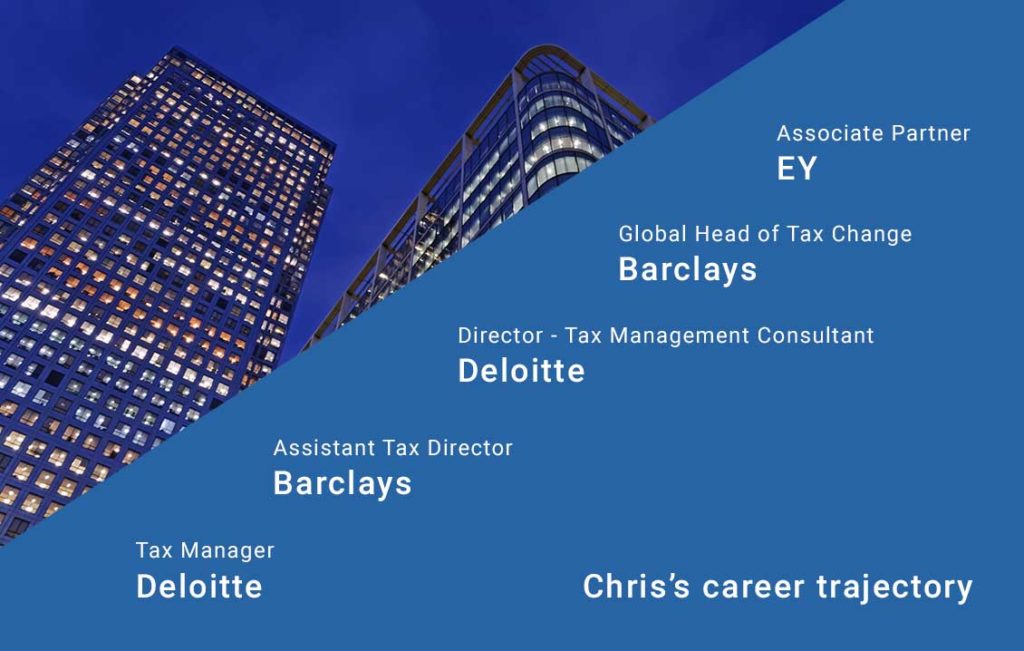
How has Chris McCandless, Associate Partner at EY, moved between in-house roles and practice and what can fellow tax professionals learn from his career? We spoke to Chris about the naysayers who questioned his focus on tax process and technology, the importance of mentors and the changing skills needed for a successful career in tax.
Top career tips for tax professionals
“Like a lot of career moves, my first big break was about being in the right place. I was offered a secondment into Barclays whilst still working in profession: focusing on tax process, technology and compliance.
Lesson one: Being well networked is key, many opportunities are random, the more people you know the more likely you’ll get those chances.
In many ways, it was a natural shift from practice and there were similarities between working at a practice firm and Barclays in terms of the challenge, people and size of the team. However, it’s impossible to understand what it’s like to navigate the complexities of working in industry, from politics to navigating how you actually get things done, unless you actually try it!
Lesson two: Create an opportunity to work in industry, it will enable you to better solve clients’ problems.
My first stint at Barclays gave me the chance to basically rebuild part of the department. It was a huge motivator to me, using what I knew but learning new skills at the same time. I’ve never forgotten the tax director who gave me that opportunity.
In practice, I did enjoy tax advisory and the legal side of things but I was really drawn to the process. People thought I was mad!
A lot of people I know who work in practice see themselves as ‘the tax law guy’ or the ‘technology person’ but in industry, it’s harder to separate out.
What tax professionals do in industry every day as part of the tax process is a combination of looking at the law, sourcing data and using technology. I liked that fusion of both law and tech. It’s still a relatively unique set of skills having that blended, holistic approach to tax. That has underpinned my career.
Lesson three: Be a rounded tax professional not just the ‘tax law person’
After we developed the tax team at Barclays and the transformation element eased off, I wasn’t quite ready to focus on a business as usual role and went back to Deloitte to apply my learning to other clients.
Four years later I had the opportunity to meet the new tax director at Barclays. He’d just moved from GE and was very focused on tech, process, controls and risk management. He gave me the opportunity to set up a change and technology function to serve Barclays globally. It was one of the most enjoyable roles in my career.
Lesson four: Make friends, Chris met the tax director through one of his friends from his first stint at Barclays
The role was very similar to working in professions as I had to sell ideas, present a vision, convince people to spend money and get projects delivered. I moved away from tax during that time.
I had the opportunity to work on an operating model transformation project – bringing teams together and centralising functions. At the end of that project, the then head of tax said why don’t you lead both the tax and change teams? I thought about it over the weekend and threw myself into it feet first!
On paper, I’d never have got this job. He recognised my blend of technology and tax skills when people were saying: “I didn’t even know you were a tax person Chris!”
Lesson five: Be bold – take a business risk with your career and give stretch opportunities to people in your teams.
That role was a validation of the skills required in a 21st-century tax department. The last ten years have really seen a shift from tax planning to tax professionals becoming managers of risk and it’s also become incredibly data-driven and tech-focused.
So the people you need to staff a tax department changed and is still changing. My blend of skills were suddenly really in demand. The naysayers definitely thought the decisions I was making were odd but this job really brought everything full circle.
This role took me back into practising tax at a time of huge cost pressures. I was constantly challenging how things were done and using technology and data to help us survive when headcount was reducing but work was increasing.
I was then able to hire more tech people and systems administrators which was a different dynamic. Now you need tax people who understand tech, that is key. A balanced team with a variety of perspectives is crucial.
You will see a lot of things like this through your career that make you think “I never understand why we do it this way.” Call those things out. That’s career-defining.
Lesson six: Challenge the status quo, most careers are made on the 5% that was exceptional and that takes a different way of thinking.
I then took some time off when my wife was unwell and when I started looking for new opportunities I saw that EY had just made a £1bn investment in tech and artificial intelligence (AI). This was very appealing to me – I’ve been there 10 months now as a partner focusing on tax and transformation.
Client needs are shifting and the tax skills of old are no longer enough. One of the things I’ve done is work with our data analytics team to bring together the skills within tax and AI. It’s a different approach to just leaving tax people to figure out AI! This is a new recruitment focus for us.
Tax is changing and the world of today is not what it will be in five or ten years. Embrace the opportunity to learn. Be open-minded – our job is to help clients so don’t worry about where the line sits between tech and tax.
Lesson seven Be open to change, whether you’re looking for a role or hiring for your tax team
I’m in formal mentoring schemes at EY now – but actually it doesn’t have to be a formal relationship for you to get that much needed sounding board. I have several mentors – although none of those people might recognise that officially.
I go for a drink with a work friend and that’s a mentor relationship to me. Almost without exception, everyone says yes to going for a drink or to formal mentoring. It’s important not to have a self-imposed barrier, thinking you aren’t good enough to talk to senior people. Everyone is there to do a great job and you have permission to do a great job too.
Reverse mentoring with those at an earlier career stage can also be extremely valuable. I had an 18-year-old colleague who I supposedly mentor but her perspective is so different to mine that she’s actually been an amazing mentor to me.
Lesson eight Draw on an eclectic mix of mentors – don’t get lost in the Canary Wharf bubble
Despite tech being at the heart of tax now, it’s important not to forget the impact on people. There’s such high competition to recruit the best graduates and the best tax professionals that being able to use tech to improve the employee proposition is critical. Even down to taking out some of the less enjoyable parts of the role – this really helps with retention. No one wants to sweat over a spreadsheet anymore.
In summary, the key thing I’ve learnt through my career is that it’s our job as tax professionals to solve problems – it could be data or legal. Keep that focus and put people and relationships at the heart of what you do and you’ll be successful.
I would also say embrace tech and data – it’s not going away. Using AI to drive things like tax classifications is reducing risks for clients and we’ll see more of this. The opportunities are endless.”
Read more about successful leaders – follow Chand Chadasuma’s advice on rising to partnership level in corporate finance. Or if you feel ready to discuss your next career opportunity in Tax, or you’re looking for talent to fill a role in your organisation, please get in touch with Rory MacSween, Director, Tax Recruitment today on +44 (0) 20 3637 7808 or connect with him on Linkedin.
Henning Lauritsen is a leader in the tax profession and has created internal tax teams for a number of large international companies. Having worked with Henning to build the tax team at Wyelands Capital, SRM Recruitment asks for Henning’s advice on how to build a tax team from scratch.
What kind of people should you look for?
It’s critical to source people who understand how to work with the business if you want to successfully build a tax team from scratch. Of course, a tax professional needs to understand compliance, but they need something more than that. It goes beyond being up to date with operations, they have to really understand the business approach.
When we set up the tax team at Wyelands Capital, we partnered with SRM Recruitment because we wanted to build a thinking tax team, not an operational tax team. We partnered to create a strategy, which was approved by the CFO, and SRM helped me to fill a number of roles. In the past, the Group’s tax department was too operational – we wanted to be real advisers. Now, the team are in place and my boss has relocated so we’ll be even closer moving forward. It’s fundamental to work closely together so the senior management can understand tax.
I think it’s more important to find balance in your team than to try and hire the ‘perfect candidate’ on paper. When we were creating our tax team at Wyelands Capital, we had some very strong theoretical tax knowledge, but we needed someone who brought more practical experience. We sourced a candidate from South Africa who had really strong practical skills, and this complemented the strengths others had. You have to think of the team as a whole.
How do you run your team?
We have one central Group tax department, but we also have satellite tax departments in Bucharest, Ostrava, Sydney and Dallas. The local knowledge is invaluable, and it keeps the dynamic fun – they love visiting the London team, and vice versa. I have always tried to set up tax teams to reflect the countries we are operating in, as well as having a gender-balanced, multicultural team. When you have the opportunity to build a tax team from scratch, I think it’s important to mirror the real-world environment and have that diversity.
In terms of rewards, teamwork is key, so for example, a bonus wouldn’t be awarded unless people work well together. They don’t have to like each other – that doesn’t matter in our department – but everyone must cooperate. I have a strong belief in the power of the team.
We hold a weekly meeting to ask everyone what they’re working on. This is also a great opportunity to share our knowledge with the business, by inviting colleagues from other disciplines e.g. procurement to talk about what they are doing and how we can help.
How can you work most effectively with tax authorities like HMRC?
The first thing to understand is that tax authorities do want to work with you. By having an honest, respectful dialogue, you can work more effectively. For example, in Malaysia, we advised the authorities that we couldn’t work to their timetable, and also that our system is approximately correct (we called it our 80% rule.) That is not unusual by the way – no matter how much you go into the detail, something will always be wrong. So, we try to be practical and realistic and explain any limitations. It actually helps us be more accurate because we are not sweating the ‘small’ stuff but making sure we are putting time into what really matters. We explained we were following OECD guidelines, and they understood.
We have a good relationship with HMRC because we are open and transparent. They joined us at a risk review and we had a very good meeting. They don’t actually like court cases – they want to solve problems.
It’s really just a case of being good corporate citizens – and not just the tax department. We’re here to help and assist, and by doing so we protect our business.
When do you bring in external expertise?
We do need to use outside experts from time to time. We did an acquisition in seven countries and to aid our understanding we used the regional PWC advisors to do the local due diligence work. We know when to ask for help and use external advisors for difficult situations.
Partnering with SRM Recruitment to build our tax team from scratch was a good use of external expertise to find the best talent for our roles. SRM acted as true consultants to our business and helped shape our hiring strategy, as well as filling the positions.
If you are planning to build or expand your tax team, please contact us to discuss your needs. For more information about Henning’s career and for his thoughts on the Future of Tax, visit our Insights section.
Henning Lauritsen, Acting Head of Tax at Wyelands Capital (GFG Alliance)
Henning Lauritsen is Acting Head of Tax at Wyelands Capital (GFG Alliance). Originally from Denmark, Henning started in international tax at petrochemicals company Borealis. He started Carlsberg’s tax team from scratch, and since then has led several global organisations through periods of transition and merger. In the latest of our ‘Lessons from Leaders’ series, we find out what Henning has learned from his career in tax.
How did you arrive at your current role?
In 2009 I was working in Hong Kong for a global commodity group. I travelled a lot – it felt like I went around the world in two weeks. Jules Verne had nothing on me! It was a very interesting company, but jet lag plagued me.
I moved to London for a new role, where I set up the global tax department. I was still travelling, visiting the US and parts of Asia to get closer to the business. When they closed the London office in 2017, I wanted to remain in the City.
Around that time, the GFG Alliance called me and asked me to focus on their M&A business – Wyelands Capital. They did things differently there, and it seemed like a great opportunity to learn, so I joined them as Acting Head of Tax. It’s a year since I started – I think they still like me!
You’ve had a very successful career in tax – what has driven your progress?
It sounds like a contradiction, but I think I have survived by not becoming too focused on the tax world. You have to understand the connections an organisation has within and outside itself, and then to work with the business to translate tax into their language. It’s just as important to understand accounting and cross-border challenges, as it is to understand people and cooperate with them.
To be successful, a tax leader cannot operate alone, and I’m a big believer in synergy. One person can dig a ditch of three metres in two hours but two people can dig seven or eight metres of ditch at the same time. That’s the power of the team.
What lessons have you learned as a tax leader?
There are three main lessons I would share with someone wanting to pursue a successful career in tax:
It’s important to be a good leader. This means working as a team – you’re only as strong as the weakest link. You have to take care of people, lead and guide them, then they will deliver.
You must think broadly. I analyse the company accounts. That’s not my job, but I proactively look for anomalies, such as the effective tax rate, so I can spot any errors sooner. I do what I call ‘the sniff test’ – if it smells wrong, it probably is. I look at the whole business through the lens of tax and take a broad view of the situation.
When you do speak to people, be clear – the way we communicate as tax professionals is critical. I can guarantee that the business does not understand what I’m talking about if I use phrases like ‘future relief’. Terminology also differs from country to country, so an international team must be sensitive to that. You have to be able to explain simply – no long stories! It’s important to pitch your communications to the person’s level of understanding.
How do you advise the business as a tax leader?
In tax, as in many other disciplines, the more experienced you are, the more you need to consider the real question you are being asked. You may only be told parts E-Z of a story, and you have to first understand A-E yourself, and research the background. To properly advise, you need to ensure answering the right question. Never take a risk if it makes you think ‘I hope no one sees’ – you are there to protect the business.
Any career regrets?
Not really! I’ve tried so many different companies, all with different cultures. I’ve had a very interesting career, and I always think that that job I have now is the most important one. I say to other people ‘don’t complain about your situation – you took the job!’. Take control, drive things forward – if you want a salary rise, ask for one and explain why.
I’m happy I chose tax – it was the right decision for me. Tax is like a piece of art of me.
How is tax like art?
If you know your legislation and how to see connections within the business, tax professionals can figure out beautiful plans to save money and serve the business. We must always consider the ethics of our actions – we don’t just do things because we can. But there is pleasure in finding solutions for the business.
For example, I had just joined one organisation and due to the way we were structured and set up historically we had to pay £5m in tax. Working in partnership with PWC, we found a solution that reduced our exposure, reduced risk and was ethical – all by understanding the law, the detail and thinking creatively.
We’ve seen how a broader understanding of the business, clear communications and the power of teamwork have driven Henning’s career trajectory. For more in our ‘Lessons from Leaders’ series, and to discover Henning’s thoughts on the future of tax, visit our Insights page. If you’d like to discuss your next tax role, please get in touch.
Henning Lauritsen is Acting Head of Tax at Wyelands Capital (GFG Alliance). We hear Henning’s three predictions for the future of tax
A closer relationship with tax authorities
In recent years, businesses have cooperated more and more with tax authorities, and the future of tax will see this trend increase as a lack of resources forces efficiencies. The authorities will ask us to implement policies, state our tax strategy on the website and get the whole company behind that strategy. If those policies are put in place, then we won’t need their audits – we have protection around the company and that makes us stronger.
Greater internal controls
The more internal controls a company can implement, the better that company will function. As technology allows our procedures to be digitised, I expect this area will grow in the near future. We can already see that digital VAT and tax creates efficiencies so that we as tax professionals have more time to focus on the company more broadly, rather than the detail.
The world is changing very quickly, and the future of tax will see many more tasks becoming automated. For example, automated transfer pricing reports will allow us to easily consult the business quickly on the markets it should sell to. These processes will also become more accurate over time.
The future of tax teams
The tax department must start to look like a thinking team, focused more on strategy and overall policy than the detail. Automation will mean the tax team reduces in numbers, and those left in it need to shift from being operational to more consultative. The tax department will be more involved in the business than they are today – among the C-suite you may see more tax professionals, lawyers and accountants. Closer integration with the business, perhaps as a virtual team rather than one separate, centralised department, will ensure the tax specialists can better guide the various teams as to what’s best for them.
In summary, it’s clear to see how better cooperation with tax authorities, more automated and efficient internal controls and a more consultative approach will shape the future of tax in the very near future. Stay up to date with the latest trends by following us on LinkedIn. To discover Henning’s thoughts on building a tax team from scratch, to learn about his career path and to access our ‘Lessons from Leaders’ series, visit our Insights section.
“We can already see that digital VAT and tax creates efficiencies so that we as tax professionals have more time to focus on the company more broadly, rather than the detail.”
Henning Lauritsen, Acting Head of Tax at Wyelands Capital (GFG Alliance).
If you’d like to discuss your tax role, or if you’re looking to make your next career move, please get in touch to talk about your needs.
“The work I’m doing around sales and building the business is very different to anything I’ve done before.”
Drew Wardrope – Head of Tax Insurance at Howden
Public speaking isn’t the first thing that comes to mind when you’re listing a tax professional’s required skills. It certainly wasn’t something Drew Wardrope gave much thought to whilst he was heading up M&A tax at Barclays. A lot has changed for him over the last 18 months – his public speaking responsibilities included. We spoke to Drew about the early days of his career, his impressive rise through Deloitte, RBS and Barclays and how a call from Rory MacSween at SRM Recruitment set him on a new and exciting path to insurance specialists Howden.
What attracted you to a career in tax?
I’d love to say I have this amazing story about how I always wanted a career in tax… but I didn’t. I basically fell into it. I was studying maths at Nottingham university and I got a job mid-way through my third year – I was going to be an actuary. That was great, I was set up, I could relax a bit. I deferred and took a year off to go travelling. I taught football in the States, toured Brazil in a campervan and then went to Asia. I was getting into a bit of debt, but I wasn’t worried as I knew I had a job to go back to in September and I’d be able to pay it off.
I’m sensing something’s about to go wrong…
This was 2003, way before smartphones, and I was checking my emails in an internet café in a railway station in Cambodia. The actuary company in London had emailed, asking me call them urgently. I found a payphone and was told that the company was laying off all its graduates. I remember sitting outside the internet café almost laughing to myself and thinking, ‘What the hell do I do now?’ I needed to find a new job pretty sharpish but when I got back to the UK in August, most decent firms had already hired for the year.
You secured a graduate role with Deloitte – how did you manage that so late in the day?
Deloitte had just gone through a big merger with Arthur Anderson, so they’d put their recruitment on hold for six months. I was living with my mum in Newcastle and I went down to London for a graduate fair expecting to speak to the Deloitte actuary guy. But I was told, ‘Sorry – all the actuary jobs were filled yesterday. But you can speak to the tax guy – he’s still got jobs available.’ So, I did and that’s how I fell into a career in tax.
You clearly settled into tax well because by year four, you were rated in the top five percent of the population at Deloitte. Then you left for a job at RBS. What made you go in-house rather than pursuing the partner track at Deloitte?
I saw moving in-house as a stepping stone to the partner track. Working for a big accountancy firm, you’re advising businesses all the time, telling them what to do and how to do it. I thought, how am I supposed to give this advice when I don’t really know what it’s like to implement it? In the real world, does this stuff actually work? Is it practical? Is it realistic? So my plan was to go in-house, get some commercial business experience and then effectively go back to Deloitte.
How was life in-house?
It was nerve wracking but exhilarating. When you work for an accountancy firm at a junior level, typically in client meetings you just listen in because you’ve got at least two people more senior than you doing the talking. I went from that sheltered environment to being told by my new boss in my first week, ‘You’re going to a meeting on funds. Do you know anything about funds? No? Well, you had better learn fast because you’re our funds expert now.’ I had a morning to read up on everything and then I went to this meeting with the front office and 10 or so other infrastructure groups and was asked, ‘So, what’s your opinion on tax?’ It was very steep learning curve, but I learned quickly.
You joined RBS in 2007, a year before it went into government ownership. How did that play out for you?
I look back now and think I lived through the eye of the storm. Senior management weren’t saying much – we got most of our information from Robert Peston on the BBC. We saw Fred ‘the Shred’ Goodwin in the treasury effectively pleading for money from Gordon Brown to keep the bank afloat. We watched other banks collapsing and people walking out of Lehman Brothers with their possessions in boxes. There were pay cuts and lots of extra work and day to day I’d go into the office not knowing if the bank would still be functioning. But we just got on with it. There was a real sense of camaraderie – we were all in the same boat and none of us had a clue about what was going to happen. You get rich, interesting experiences from something like that.
You stayed with RBS for two more years and moved to Barclays, which in 2012 found itself in its own media spotlight…
Yes, I somehow chose to work at two companies at the centre of some of the biggest corporate scandals in UK history! At Barclays it wasn’t our financial stability that was in question, it was our reputation. I think it changed the bank for good in that pre-financial crisis, banks were participating in tax schemes that were legal but morally questionable. Post financial crisis, people started thinking about the wider effects of aggressive tax planning – it’s legal, but is it the right thing to do?
After seven years at Barclays, what made you decide to move on?
My last three years at Barclays were amazing. I became head of M&A Tax at a time when Barclays was massively downsizing and selling about a third of the bank. I built a tax team to support that and we did loads of interesting transactions in a very short space of time. It was really fun, but it had a shelf life – the role was only so interesting so long as there was stuff to sell or buy. I could see that by the end of 2017, Barclays would have sold all it wanted to sell and my role would be coming to an end. So I started thinking about my next steps.
Was going back to Deloitte an option, as per the plan you’d had ten years earlier? And where do SRM Recruitment and Howden fit in?
I was talking to various firms about roles in M&A tax, including Deloitte. I was working on a deal in Johannesburg when Rory from SRM Recruitment popped up – he reached out to me on LinkedIn and told me he had a role that he thought was perfect for me. Ultimately he was right, because here I am at Howden! What interested me about the role was the opportunity to go out there and try to grow a business, which I’d never done before.
How fast did things move after that first email from Rory?
Unbelievably fast. It was in huge contrast to the bureaucratic, red tape environment I’d come from, where you can have six rounds of interviews and still no final answer. I had an interview with Howden’s MD on the Friday, met his colleague on the Monday morning and by Monday afternoon I had a job offer.
So you’re now Head of Tax Insurance at Howden – congratulations! Tell us about the workplace culture there.
It’s completely different to anywhere I’ve worked before. We’re majority owned by a bigger organisation but minority owned by employees, and there’s 40 of us globally in M&A. The team was created six years ago and it’s grown exponentially year on year. There’s a start-up feel to the place – it’s a really fun, exciting place to work. There are yoga sessions in the morning and everyone walks around in their sports gear. So it’s not your typical corporate world, but that’s not to mistake the fun for lack of professionalism. When we’ve got client meetings we’re all suited and booted and everybody works very hard, if not harder than in places I’ve worked in before.
Can you give us an overview of what you’re doing at Howden?
I sell tax insurance products. Let’s say a buyer puts £500 million on the table for a new business which has a £100 million tax risk. The next day that tax risk crystallises – the business is now worth £400 million and the buyer is out of pocket. I sell the tax insurance products to the buyer to protect them from that risk. Without insurance, the deal might not happen because the buyer and seller can’t agree how to share that risk. If you transfer that risk to the insurance market and both parties are happy to pay the cost of the insurance policy, which is a percentage of the total overall risk, the deal gets done.
What’s it like applying your technical tax skills in such a different environment?
As far as the technical tax skills go, the application isn’t that different from my previous roles. When you work in M&A you have to become a generalist – one day you might be looking at VAT risk in Singapore, the next it’s transfer tax in Italy. That part of my work hasn’t really changed.
So what is different around your current role – and what new skills have you developed as a result?
The work I’m doing around sales and building the business is very different to anything I’ve done before and I find it really interesting. The workload is intense: I’m working on deals, servicing existing clients and all the time trying to grow the business and make new contacts. There are lots plates spinning and you need energy and mental resilience to take all that on and not get too stressed by it. Work trips can be exhausting: we’ll do seven meetings in a day, from sitting around a table having coffee to presentations to 100 people.
And how have you embraced your new public speaking responsibilities?
Turning up at a conference and speaking for an hour to 100 delegates wasn’t something I’d done before. I do get a bit nervous beforehand, but generally I’ve been pleasantly surprised by my public speaking abilities!
What advice would you have for tax accountants in the early stages of their careers – or what would you tell your 22-year-old self starting out at Deloitte?
I’d say that it’s really important to make your own luck. There are so many things you can’t have a hand in – it’s just about being in the right place at the right time. But what you can do is try to make as many opportunities arise as you can. Do this by putting yourself out there and meeting people. The more you’re getting out there, the more opportunities will arise and when they do, you can grab them. The book Outliers: The Story of Success by Malcolm Gladwell was eye-opening for me. He writes about Bill Gates and how he happened to have regular access to a computer in the 1960s, way before computers became mainstream. So many moments are about luck, and it’s about recognising those moments and seizing them.
Discover more stories in our ‘Lessons From Leaders’ series in our blog. If you’d like to discuss your next career change, we’d love to hear from you, so please get in touch on + 44 (0) 20 3637 7808. Or submit your CV here.