Why Tax Professionals Should Stop Judging In-House Roles by Job Title

Tax professional at desk
By James Rodgers, Head of Tax Recruitment

For tax professionals considering their first move from practice into industry, one of the biggest misconceptions can be surprisingly simple: assuming that a job title tells you everything you need to know about a role.

In practice, titles are largely standardised. Whether you're at a Big Four firm, a mid-tier practice or a law firm, there is a fairly well-understood hierarchy. Analyst, Associate, Senior Associate, Manager, Senior Manager, Director, Partner. Each level carries broadly similar expectations around experience, responsibility and compensation.

However, industry doesn't work that way.

Once you move in-house, job titles become far less reliable as a measure of seniority, scope or earning potential. Every business creates its own organisational structure, and titles often reflect internal conventions rather than any market-wide standard.

As a result, two people with the same title can be doing vastly different jobs, while two completely different titles can represent almost identical levels of responsibility.

I've seen this play out repeatedly across the tax market.

Recently, I worked on a Tax Associate role within an investment management fund. The total package exceeded £110,000 and the ideal candidate profile was a Manager from a recognised accounting firm. The role offered exposure to a sophisticated fund environment, significant responsibility and genuine long-term progression opportunities.

Yet several strong candidates ruled themselves out before even exploring the opportunity because they saw the word "Associate" and assumed it represented a step backwards in their career.

In reality, the role was anything but junior.

This is one of the biggest traps tax professionals can fall into when evaluating opportunities in industry.

Why Titles and Compensation Don't Always Align

The disconnect becomes even more obvious when you look at compensation.

In practice, progression and salary are closely linked. Move up a grade and your remuneration generally follows a predictable path.

In industry, that relationship can look very different.

I've seen Tax Managers at large, listed businesses earning less than Tax Associates at private equity funds. I've seen Heads of Tax at smaller organisations earning less than Senior Managers in practice. Equally, I've seen Analyst-level positions at well-capitalised investment firms offering packages that would surprise many experienced tax professionals.

The reason is simple: businesses don't price roles based primarily on what the title sounds like.

They price them according to the value of the skill set required, the complexity of the work, the level of responsibility involved and the commercial realities of the business itself.

A growth-stage fund with a lean finance function may need one individual to take ownership of a significant portion of the tax agenda. Internally, that person might be called an Associate, a Manager or something entirely different. The title is largely irrelevant. The compensation reflects the importance of the role.

Conversely, a large multinational may have an impressive-looking hierarchy full of Director or Associate Director titles, but with relatively narrow remits and multiple layers of management. In those situations, the title may sound senior, but the scope and remuneration can tell a different story.

What Tax Professionals Should Focus on Instead

When assessing an in-house opportunity, the questions that matter most rarely relate to the job title itself. Instead, focus on:

Total compensation

Look beyond base salary. Consider bonus potential, long-term incentives, carry arrangements, pension contributions and wider benefits. The overall package often tells a more accurate story than the title.

Scope and ownership

What will you actually be responsible for? Will you own key tax processes and decisions, or will you be supporting someone else who does?

Complexity of the tax work

Consider the size of the tax footprint, the jurisdictions involved, transaction exposure and the technical challenges you'll encounter. Complexity often creates career-enhancing opportunities regardless of title.

Career progression

How is the team structured? What does progression look like over the next two to five years? A seemingly modest title today may offer a far stronger long-term trajectory than a more senior-sounding alternative elsewhere.

The business itself

Where is the company heading? Growth, acquisitions, fundraising activity and international expansion can all significantly influence the opportunities available within a role.

Don't Let a Title Make the Decision for You

One of the biggest differences between practice and industry is that job titles lose much of their predictive value.

The title alone rarely tells you how much you'll earn, how much responsibility you'll have or how valuable the experience will be for your long-term career.

Yet many tax professionals still filter opportunities primarily through that lens, particularly when considering their first move in-house.

That can mean overlooking roles with exceptional compensation, greater autonomy, broader exposure and stronger progression prospects simply because the title doesn't match expectations.

The most successful moves into industry tend to come from candidates who look beyond the label and focus on the substance of the opportunity.

Because when it comes to in-house tax roles, what the job is often matters far more than what it's called.

get in touch

Looking to make a move in-house or hire your next in-house tax professional? Contact James Rodgers, SRM's Head of Tax Recruitment, on jamesrodgers@srmrecruitment.com or call +44 (0)7852 322955.

SRM: The First Decade

celebrating 10 years of SRM

There is a particular kind of madness that grips people when they decide to leave perfectly good salaries behind and start something from scratch.

It might include a good helping of self-confidence, a light sprinkling of bravado, and a detailed business plan that doesn't survive initial contact with reality. In the case of Andrew Setchell, Stewart Robertson and Rory MacSween, who between them comprise the ‘S’, the ‘R’, and the ‘M’, of SRM - it also entailed the ability to respond rapidly to an unrelenting decade of events, and emerge smiling at the other end.

After 10 years in business, SRM Recruitment has grown from three men and an idea into one of London's most respected specialist recruitment consultancies - placing senior finance, tax, legal and M&A insurance professionals across the UK and internationally, with offices in London, Guildford and Welwyn Garden City, and a team of over 20 specialised professionals.

Easter 2015. Over the top.

The founding story began, as many good ones do, with a question that needed answering. Andrew Setchell had spent four years as an accountant at PWC before moving into recruitment in 1996, eventually running large teams at Michael Page and Robert Walters. By Easter 2015, he was considering the next decade, and wondering ‘why’? Why had the industry where he’d worked for twenty years traded genuine consultancy for the kind of relentless, funnel-driven, phone-bashing culture that made good recruiters miserable and clients feel like they were being processed rather than helped?

"I always wanted to do my own thing, but I'd never do it by myself," Andrew says. "I needed like-minded people." He found two.

Rory MacSween had come to recruitment via a rather more scenic route; the British Army, then Michael Page and Robert Walters, before carving out a niche in the then-nascent world of M&A insurance. Stewart Robertson, a Modern History graduate from Royal Holloway who had also come through the big corporate recruitment machine, had arrived at similar conclusions independently. "We were all having the same conversations," says Rory. "It felt very transactional, like you were turning a wheel. Hard to put your stamp on something."

What gave them the final push? A developing conviction that there was a ‘better way’ - borne of watching floors empty during the financial crisis, observing management endlessly meddling, and noticing the business become, as Andrew puts it, "all about volumes". "The big corporate firms believed the brand was bigger than the person," says Andrew. "But for a medium-sized player, it's far more relationship-driven.” The new way had to be different. More consulting, less funnel. More relationship, less brand.

They handed in their notices in March 2016, collected their bonuses, and launched SRM just as the country was about to vote on Brexit. "We thought: Conservative majority, remain wins, markets go boom, we catch the wave," recalls Stewart, with a rueful laugh. "Yeah."

The First Year: Hard Lessons and Good Hires

The early days had a certain chaotic energy. For a while Stewart worked from his back garden shed. Rory and Andrew sat at a shared WeWork at Fox Court, where the ping pong tables and complimentary evening beer represented either a wonderful startup ecosystem or a terrible productivity environment, depending on the time of day.

The business plan — built partly on the assumption that blue-chip client accounts would follow them from their previous employer — "was out the window within twelve months." More pressingly, litigation arrived in the form of legal letters from past employers, designed, as Andrew notes, "to take up oxygen." It worked, for a while, but was resolved. "It did take a toll," he says. "But it also tempered the risk. You learn a lot about people. And about each other.”

But the wins came. After ten or eleven months of grind, they had back-to-back strong months. The model was working. Rob McKay and Dave Kingston, two early hires who took a genuine leap of faith, are name-checked with real warmth; "they came when we were literally nothing, and remain central figures in the business today.”

The Decade in Brief: Brexit, Covid, and the M&A Freeze

SRM has been tested by just about everything the last decade could throw at it. Brexit, which was timed with spectacular bad luck to coincide with their launch, initially caused a sharp intake of breath before proving broadly manageable. Covid was different.

"Bar one client, all live mandates were cancelled or put on hold indefinitely," says Stewart. "Overnight." That single remaining client — who happened to complete an acquisition at the exact moment lockdown was announced and needed an entire finance function recruited — thankfully kept things ticking over. Then, almost as suddenly as it had stopped, the market came roaring back. 2021 and 2022 were "by far our most successful years." Brexit had thinned the pool of European talent, demand was surging, and SRM leaned hard into genuine consultancy; helping clients navigate everything from sponsorship licences to employment law.

Then came 2023. The M&A market, which had been running hot, cooled sharply as interest rates rose and deal flow dried up. "Summer 2023 was still pretty good," says Andrew. "Then the kids went back in September and it wasn't the same September as the year before."

They navigated it, as they have navigated everything, by staying lean, diversified — and doing what smaller, more agile ‘boutique’ firms can do better than large ones: pivot fast — "it's rare that every part of our business is pulling back at exactly the same time, and that is a strength not a weakness.”

What Makes SRM Different: ‘Relationship Led. Data Driven.’

Ask the founders what sets SRM apart and you get a consistent answer: they recruit experienced people, give them autonomy, and get out of the way. No KPIs. No call-rate targets. No boiler-room atmosphere. Flexible working was already the norm at SRM, before Covid ever arrived. "The least experienced person in our business has seven years of recruitment experience," says Andrew, "we gladly recruit people with grey hair. With no hair…" he adds with a knowing smile.

The approach — which they describe as closer to search than traditional contingent recruitment — is built on a simple observation: the best outcomes come from relationships, not volume. "You just need really good relationships to get the same return without the flannel," says Andrew. "The big firms didn't work that out because they thought the brand was bigger than the person."

The Next Ten Years

"Everything you hear is how quickly AI is going to change our world", says Stewart, sanguine but clear-eyed about the future. The consensus among the founders is that AI will help them work faster, but that the fundamental value of what they do — human judgment, market intelligence, discretion, the ability to sit over lunch and map out someone's career — is not something an algorithm can replicate. "I had lunch with a client last week," says Rory. "We drew up a list of businesses he was interested in. By 5pm I had him an interview at one of them. I can't envisage a world where AI does that. Human interaction can’t be overrated.”

Andrew has a bolder prediction: as AI takes over junior professional work and graduate hiring shrinks at the big firms, newly qualified accountants and lawyers will become rarer and therefore more valuable. "Supply goes down, price goes up.” As for what comes next for SRM itself: growth, yes. New sectors, possibly. Selling? "We've never seriously sat down and discussed it," says Andrew, adding, “we want to create a space for every employee to earn six figures.”

And the most important thing about the next decade? "If we have a business in ten years that still holds the values we set out with," says Rory, "I'd be incredibly proud of that.”

Record Profitability Masks Growing Tensions in the London Legal Market

London lawyers
London lawyers

London's legal sector delivered extraordinary financial results through 2025, with law firms posting record revenues and profits that appear to validate the city's continued dominance as a global legal hub. Partners at elite firms have celebrated unprecedented earnings, and the broader UK legal services industry demonstrated remarkable resilience despite economic headwinds. However, underneath all the champagne headlines and billion-pound fee announcements, multiple warning signs suggest the foundations supporting this success may be less stable than they appear.

Unprecedented Financial Performance

In 2025, collective revenues for UK law firms sailed past £52 billion, with elite firms capturing an ever-larger share.

Linklaters posted a record revenue of roughly £2.3 billion with profit per equity partner (PEP) at £2.2 million. Clifford Chance reported 9% revenue growth to £2.4 billion with partnership profit surging 11% to £944 million and PEP at £2.11 million. Ashurst broke through the £1 billion revenue barrier, growing 8% to £1.03 billion with PEP at £1.39 million. A&O Shearman's transatlantic merger created a £2.9 billion global heavyweight.

Mid-market firms continued to thrive. NatWest's 2025 survey showed median fee income growth reaching 12% in 2025, up from 10% in 2024. Across the top 100 firms, 84% reported profit increases, compared to 56% the previous year. Average PEP across top 50 firms rose 6.2%, with the highest-paid Clifford Chance member taking home over £7 million, according to City AM.

What Drove Growth

Transactional work rebounded strongly through 2025, with private equity fuelling London's most valuable mandates. Kirkland & Ellis recorded a landmark year, surpassing $1 trillion in announced M&A deal value globally.

The talent war also saw a dramatic acceleration. London firms hired 668 partners in 2025, a 21% increase from 2024, with US firms continuing to dominating growth. Top newly qualified salaries at US firms now stand at £200,000, which has forced Magic Circle firms to increase their salaries as well to remain competitive. 

Practice areas showed varied performance, according to NatWest’s 2025 survey. Private client teams led growth (34% of respondents), followed by residential property (14%). An optimistic 89% of firms expect fee income to continue to increase further in 2026.

Despite aggressive investments, firms managed to maintain discipline. Overall people costs declined from 65% to 64% of revenue. However, headcount growth expectations tempered for 2026, reflecting persisting economic uncertainties.

Warning Signs Emerge

Despite the impressive headlines, some concerning structural trends emerged. The most significant challenge comes from intensifying US firm competition fundamentally reshaping London's market. US firms including Latham & Watkins, Kirkland & Ellis and Simpson Thacher now generate larger UK revenues than legacy British firms. According to a 2025 Lawyer Magazine article, Kirkland & Ellis is on course to become the largest firm by UK revenue, which would be a watershed moment marking the first time a US firm achieved such dominance in what has traditionally been the preserve of homegrown institutions.

The compensation arms race poses serious sustainability concerns as well. The dynamics create what one senior partner described as an "impossible equation" of raising billing rates faster than costs while trusting realisation will follow. Some leaders have publicly called the pay explosion "not sustainable". Competition for talent is expected to remain intense through 2026, with law firms looking to make accretive hires which shift the dial in their favour, and escalating rainmaker pay continuing in spite of economic uncertainties.

Market consolidation has accelerated dramatically. The wave of legal mega-mergers, which include A&O Shearman, HSF Kramer, and announced combinations like Hogan Lovells with Cadwalader and Ashurst with Perkins Coie, signals that cross-Atlantic scale now matters more than tradition. These mega-combinations serve a relatively narrow market segment, potentially sharpening differentiation for independent UK firms.

However, demand patterns for practices have diverged. According to the Natwest 2025 Survey, while regulatory practices thrived, firms identified litigation (23%), family law (22%), and commercial work (21%) as most underperforming in early 2026. For some practices, regulatory oversight and margin pressure make certain areas structurally harder to operate profitably.

Mounting Client Cost Pressure

Corporate clients are becoming increasingly sophisticated and price-sensitive, expecting transparent pricing, faster turnaround and streamlined communication. Many of these clients have reassessed legal panels and budgets, pushing firms to justify rate increases or face work migrating to lower-cost providers or in-house.

According to the Legal MBA, legal services price inflation reached 6.7% in Q4 2025, significantly hotter than the 2.9% average for all other professional services. However, aggressive rate increases mask underlying problems. While 96% of firms increased hourly rates in 2025, cash flow predictability has become a major concern.

Nearly 90% of firms confirm increased write-offs, with 88% expecting further increases in 2026, which has risen sharply from 49% in last year’s report from BigHand. Write-off escalation also reportedly intensified by nearly 40% year-over-year. Roughly 90% reported increased client discounts and write-downs, with nearly one-third citing discounts of 11-20%.

Potentially the most concerning, the same BigHand report found that aged work-in-progress became the primary cash-flow pressure driver for 50% of firms, up from 32%. This suggests firms complete work but struggle to convert it into cash, whether due to client payment delays, billing disputes, or difficulty justifying full value. Revenue figures may appear healthy, but there's a widening gap between projected profitability and actual cash collected.

"With firm-wide AI integration becoming the rule, clients are pushing for efficiency gains to be passed down as cost savings. Instead, they're seeing another round of rate increases and reconsidering value," notes BigHand's Global Legal. This fundamental tension of investing in efficiency while raising prices creates a credibility problem with sophisticated clients.

The US Firm Threat and Strategic Responses

US firms bring a fundamentally different operating model, which challenges Magic Circle positioning. They generate higher revenue-per-lawyer globally, creating flexibility for higher compensation without proportionately compressing partner distributions. This derives from higher billing rates, leaner staffing pyramids, more selective partner promotion, and aggressive lockstep unwinding concentrating profits among fewer equity partners.

Quinn Emanuel reported London profits of £153.9 million in 2025, reinforcing its status as a financially compelling disputes platform. The firm's profitability demonstrates that specialist positioning with premium pricing can generate extraordinary returns without a full-service platform.

UK elite firms reposition their strategies in response. Freshfields, Clifford Chance, A&O Shearman and Linklaters all reported growth in US revenues, with the US accounting for increasing shares of total turnover. A&O Shearman reported £707 million in US revenues, which is 25% of total turnover. This has increased from 13% pre-merger. This strategic pivot represents a fundamental bet that future profitability requires substantial American revenue.

For UK talent, the challenge is existential. Why pursue Magic Circle partnership at £2 million PEP when US firms' London offices offer comparable compensation with better leverage, higher-profile work, and clearer international mobility paths? The profitability gap between elite and mid-tier players continues widening, and US firms systematically exploit this disparity.

Escalating Costs and Regulatory Pressures

London firms confront rapidly escalating costs threatening to outpace revenue growth. Rising operational costs are driven by salary inflation and investment demands in technology and compliance. Legal firms are facing cost increases that are consistently outpacing general inflation.

Technology investment becomes harder to defer as clients demand firms prove AI delivers measurable value, not just efficiency promises. While over half of the top 50 firms see benefits from AI, there's growing apprehension around price erosion that widespread AI adoption may create. The technology paradox is stark: firms must invest heavily in systems that may ultimately reduce the billable hours they can charge.

The Outlook for 2026 and Beyond

The outlook for London's legal market throughout 2026 presents a complex mixture of opportunity and uncertainty. Industry commentary suggests the UK legal services market is forecast to grow in 2026, with expansion expected across most core practice areas as conditions stabilise. From a recruitment perspective, 2026 is shaping up to be more active and opportunity-rich than recent years, suggesting firms remain confident about future demand.

Yet there are still potential hazards on the horizon. The market enters 2026 "not just active, but structurally evolving," shaped by three forces: continued US firm rise in London, sustained talent competition, and UK firms' strategic pivot toward deeper US exposure. This reflects where firms are placing long-term strategic bets about future profitability and competitive positioning.

Geopolitical pressures, cyber threats, and AI's disruptive potential create a challenging environment dividing firms and increasing the imperative for greater resilience. Economic pressure continues influencing business decision-making and client behaviour.

For firm leaders, strategic imperatives are clear. To drive profitable growth, firms need to distinguish themselves through effective execution rather than simply outspending competitors, with targeted investments in marketing and business development, carefully selected lateral hiring bringing genuine client relationships rather than just credentials, and fundamentally improved pricing strategy and financial controls. Leading firms now directly link partner compensation to working capital and lock-up performance, recognising pricing must be based on demonstrated value and supported with detailed budgeting tools.

The fundamental tension grows increasingly acute: firms invest heavily in technology for efficiency while billing predominantly by the hour, compete in a talent war pushing compensation above sustainable levels, and face sophisticated clients who understand exactly what they're purchasing and are prepared to move work elsewhere if the value equation doesn't make sense. As one industry observer notes with stark clarity, "2026 will be the last year for firms to get away with rate increases as standard practice".

The question facing London's legal market is not whether the city will remain a global legal hub; its advantages in legal system quality, concentration of sophisticated clients, time zone positioning, and accumulated expertise are too deeply embedded to disappear quickly. Rather, the critical question is which firms will successfully navigate the difficult transition from today's high-profit, high-cost equilibrium to whatever market structure emerges when mounting client pressure, technology-driven disruption, and intensifying competitive dynamics finally force fundamental adaptation. Those firms and firm leaders who mistake today's altitude and current profitability for permanent stability may find themselves dangerously unprepared when market conditions inevitably shift.

Get in touch

Gwen Shaw is a legal consultant at SRM – for advice on the market, support to hire, or help in securing your next legal career move, contact Gwen on gwendolynshaw@srmrecruitment.com or call +44 7957 986390.


The BESS Talent Trap: Why Your Solar Team is Struggling to Scale

solar energy
solar energy

The UK energy storage market is no longer a "side bet" for renewable developers. As we move through 2026, it’s a $40 billion global industry, and the UK is its most complex, "merchant-rich" proving ground.

But here is what I’m seeing in the market right now: The talent that built your solar and wind portfolios isn't necessarily the talent that will optimise your BESS assets.

Here is why the entire finance stack might need a rethink.

The CFO – From Yield Manager to "Revenue Engineer”

In solar, the CFO manages a passive asset. It’s weather-dependent and PPA-backed. It’s linear.

BESS is a dynamic trading instrument. Your CFO now needs to be a technical-financial hybrid.

  • The reality: In the UK, they are managing a "Revenue Stack"; balancing the Balancing Mechanism (BM), wholesale arbitrage, and ancillary services.
  • The advice: Stop looking for "Infrastructure CFOs." I’m finding the best success headhunting from Commodity Trading desks - people who are comfortable with sub-hourly volatility and "commercial nimbleness".

The Financial Controller – The Guardian of Multi-Market Complexity

A BESS Controller does more than just close the books. They are the ones navigating the integrity of an electrochemical system that performs thousands of cycles.

  • They aren’t just looking at O&M costs. They have to audit Augmentation CAPEX - the mid-life cost of module replacement (often 15–25% of the original build) that can make or break a project's IRR.
  • The advice: Look for Controllers with Fintech or SaaS backgrounds. They are used to high-volume, platform-based revenue models and "build-operate-transition" environments.

The Analyst – The Engine Room Needs an Upgrade

If your Analyst’s Excel model is "technology agnostic," your forecasts are fiction.

  • The shift:We’ve moved past static P50/P90 models. Today’s BESS Analysts must model Levelised Cost of Storage (LCOS) while factoring in battery physics like Depth of Discharge (DoD) and Round-Trip Efficiency (RTE).
  • The advice: We are prioritising candidates with Python or SQL proficiency. You need people who can bridge the gap between "Digital Twin" operational data and financial performance. Consider profiles from TS teams who may have brokered deals involving BESS assets.

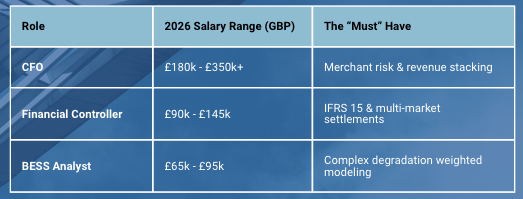
The 2026 Salary Reality Check (London/UK)

The talent crunch is real, while with unemployment on rise, profiles with genuine BESS experience is still very limited. If you want the top 1%, you have to move at market speed.

2026 Salary Table

Recruitment Tip: The best talent is off the market in under 21 days. If your interview process takes six weeks, you’ve already lost.

My Advice – Precision over Growth

You can't solve this by just "adding bodies." You need to solve it with precision hiring, identifying key skillsets rather than focusing on renewable energy experience.

  1. Pivot your sourcing:Look at power trading, infrastructure PE, and advanced manufacturing.
  2. Technical Fluency is non-negotiable:Your finance team must understand battery chemistry and grid physics to protect the P&L.
  3. Data Operationalisation:Ensure your data teams report to finance, not just ops. From meeting many BESS CFOs over the past 12 months it’s clear that being able to manipulate and model quite specific industry data and still understand the fundamentals of finance is key.

Final thought:

This is high growth and competitive market place with a limited pool of profiles with genuine BESS experience, therefore an openness to skillsets and mindsets are key. Looking at other players in the renewable energy space, won’t necessarily deliver the skillsets you need.

I specialise in finding the 1% who actually understand the BESS stack. If you’re building a technical-finance powerhouse, let’s talk.

Tom Harrington - Practice Lead | Energy, Renewables & Infrastructure

e: tomharrington@srmrecruitment.com

m: 07777 156692

US mergers and the narrowing strategic choices for UK law firms

US law mergers
US law mergers

The last two years have clarified something many UK law-firm leaders have privately suspected for some time: the centre of gravity in global legal services has decisively shifted west.

The merger that made this impossible to ignore was A&O Shearman; not simply because of its scale, but because of what it represents strategically. This was not a defensive tie-up, nor a regional expansion play. It was a recognition that the economics, client demand and competitive intensity of the modern legal market are increasingly set by the US, and that UK firms acting alone are structurally disadvantaged in that environment.

A&O Shearman has effectively become the reference point: a UK heritage firm choosing to hard-wire US strength into its core rather than compete from the outside.

From aspiration to inevitability: the US question

For years, UK firms pursued internationalisation through office openings, best-friend networks and selective lateral hiring in New York. Those strategies now look insufficient. US firms have continued to pull away on private equity penetration, partner profitability, litigation firepower and balance-sheet resilience - all while clients increasingly expect seamless transatlantic delivery. That context explains why recent and proposed combinations share a common feature: a US anchor.

The planned combination between Winston & Strawn and Taylor Wessing, trading as Winston Taylor, is illustrative. It is not about geographic coverage for its own sake; it is about marrying US litigation and disputes heft with a strong UK and European commercial platform. The logic is straightforward: high-stakes disputes and investigations are US-led growth engines, and UK firms need meaningful access to them.

Similarly, the proposed merger between Hogan Lovells and Cadwalader underlines how scale and US capital-markets credibility are becoming prerequisites rather than differentiators. If completed, it would lock in deep Wall Street capability alongside a global regulatory and transactional platform. The announced intent between Perkins Coie and Ashurst follows the same pattern. This is not a UK firm “adding” a US office; it is a structural combination designed to rebalance revenue mix, sector exposure and client access in favour of US-driven growth areas such as technology, energy transition and complex disputes.

Why UK-to-UK mergers no longer move the needle

What’s striking is not just the deals that are happening, but the ones that aren’t. Large UK-only mergers have largely disappeared from serious strategic discussion. Combining two UK firms may create domestic scale, but it rarely solves the underlying challenges: limited US revenue, shallow private-equity relationships, or the ability to pay and retain elite talent in New York and Washington.

In that sense, consolidation among UK firms increasingly feels cosmetic. It rearranges market share at home without materially improving competitive positioning abroad.

By contrast, a credible US merger offers:

  • immediate access to US-led clients and mandates
  • stronger litigation and investigations capability
  • higher revenue ceilings and partner earning potential
  • greater relevance to global GCs rationalising panel relationships

A word on timing

What’s changed most in the last two years is not appetite, but optionality. Five years ago, a US merger was one of several strategic routes open to UK firms. Today, for many, it is the only route that materially alters trajectory.

The firms moving now are doing so from positions of relative strength: choosing partners, shaping governance and setting the narrative. Those that wait risk negotiating from necessity rather than strategy; and in consolidation cycles, timing often matters as much as ambition.

A&O Shearman may ultimately be remembered less as the biggest merger of its era, and more as the moment when the market quietly accepted that the future of elite UK law firms is increasingly inseparable from the US.

Recruitment is where this strategy becomes real

If mergers are the headline, recruitment is the proof. At the top end of the market, partner and senior associate expectations are increasingly shaped by US compensation bands, faster progression, deeper benches and clearer sector focus. Firms with meaningful US integration are simply better placed to compete for that talent, both offensively and defensively.

For UK firms without a credible US story, recruitment friction is becoming more visible:

  • high-performing partners question long-term earnings ceilings
  • associates compare transatlantic exit options earlier in their careers
  • and lateral conversations increasingly start with one question: “What’s the US angle?”

Conversely, firms pursuing US mergers are not just buying scale, they are resetting their talent proposition. Access to US workstreams, cross-border origination credit and globally competitive remuneration frameworks changes who will listen, who will move and who will stay. In that sense, recruitment may be the clearest signal of where this market is heading. The firms that solve the US question structurally will continue to attract disproportionate talent; those that don’t may find the war for people is lost long before the war for clients even begins.

get in touch

If you need help to hire legal professionals for your firm, or seek your next legal career move, please get in touch with Chris Excell, Head of Legal Recruitment on chrisexcell@srmrecruitment.com or call +44 (0)7946 142731

Finance success stories: Finance Shared-Service Centre

finance case study
finance case study

Dedication, efficiency, professionalism and results that exceed expectations.

The challenge:

A prominent global consultancy firm embarked on a major transformation of its finance function. With finance professionals operating across 11 countries, the organisation sought to improve operational efficiency and streamline processes by establishing a Finance Shared Services Centre (FSSC) in the Southwest of the UK.

Given the geographical spread of the business, there were significant challenges related to time zone differences and varying levels of language proficiency. The immediate priority was to establish the FSSC and bring it into operation within four months. This ambitious timeline included the recruitment of 48 finance specialists across key functions; payables, receivables, financial accounting, FP&A, data and systems & transformation.

The solution:

1. Candidate Pool Creation

We developed a robust and diverse talent pipeline by utilising job boards, social media, referrals, and our internal database. Candidates were pre-qualified against detailed job specifications to ensure alignment with the client’s requirements.

2. SIFTING and screening

Our team conducted thorough CV reviews and pre-screening calls, followed by tailored assessments where appropriate. This process enabled us to identify high-calibre candidates and present a refined shortlist for further consideration.

3. First interviews by SRM

SRM carried out structured first-round interviews to assess cultural fit, communication skills, and role suitability. Detailed feedback was compiled and shared with the client to support informed decision-making.

4. client interview days (on-site)

We organised and managed multiple dedicated interview days at the client’s premises. SRM oversaw all logistics, ensured seamless scheduling, and provided real-time support to both candidates and interviewers. This approach significantly accelerated the interview process and enhanced stakeholder satisfaction.

5. offer management

Once final selections were made, we managed the offer process end-to-end. This included drafting and issuing offers, handling negotiations, and ensuring timely acceptance. Our proactive communication helped reduce offer withdrawals and improved conversion rates.

The results:

  • 48 vacancies filled: All roles successfully filled on time and within budget
  • 100% interview day attendance: Excellent scheduling and candidate commitment
  • 98% offer acceptance rate: Strong candidate engagement and compelling offers
  • Time-to-hire reduced by 45%: Streamlined processes and efficient coordination

What the client has to say:

"I just wanted to sincerely thank you and recognise the incredible work you've done. Successfully recruiting over 40 people in such a short period of time is no small feat - it’s a remarkable achievement that speaks volumes about your dedication, efficiency, and professionalism. Your ability to manage such a high-volume recruitment process while maintaining quality and speed has made a significant impact on our team and the business. You've not only met expectations - you’ve exceeded them.” Head of Financial Operations

Download the Case Study PDF

Need help to hire for your Finance team? 

Contact Danny Savino on +44 (0)7375 409089 or dannysavino@srmrecruitment.com

The Quiet January Rush: Why Most In-house Tax Teams Are Already Under-resourced

in-house tax under pressure
January is often seen as a “soft start” to the year. In reality, for in-house tax teams, it’s anything but. While the external perception is that hiring decisions will come later in Q1 or even Q2, what we’re seeing on the ground tells a different story: many tax teams enter January already under pressure, under-resourced, and playing catch-up.

Budgets are signed off late – but the pressure is immediate

One of the biggest challenges each January is timing. Headcount budgets may only be finalised late in Q4 or even early January, yet the workload doesn’t wait. Reporting cycles, audits, business planning and regulatory obligations all land at once. The result? Teams start the year knowing they need additional support but without the luxury of a long lead time to hire. This creates a sense of urgency that isn’t always visible from the outside – but it’s very real internally.

Regulatory and reporting deadlines don’t move

Tax is one of the few functions where deadlines are immovable. Whether it’s compliance, reporting, governance or dealing with increased scrutiny, the demands of the role continue to rise year on year. In January, those pressures feel particularly acute. Teams that were already stretched in Q4 often carry that strain straight into the new year, especially if vacancies have been left open longer than planned.

Vacancies linger longer than expected

A common theme I continue to see is tax roles remaining unfilled for months longer than anticipated. Sometimes that’s due to cautious decision-making. Sometimes it’s driven by unrealistic expectations around the candidate market. And sometimes it’s simply because hiring tax talent takes longer than other finance roles. The unintended consequence is that existing team members absorb the workload – often quietly – which increases burnout risk and makes future hiring even harder.

Why reactive hiring leads to weaker outcomes

When hiring becomes reactive, compromises follow:
  • Rushed processes
  • Narrow candidate pools
  • Over-reliance on the “perfect CV” rather than the right capability
Ironically, this often results in longer vacancies or sub-optimal hires, reinforcing the cycle of under-resourcing.

The positive shift we’re seeing for Q1 2026

The good news? There is a more constructive mindset emerging as we move into Q1 2026. More Heads of Tax are:
  • Planning earlier, even if start dates are later in the year
  • Using interim solutions to stabilise teams during peak periods
  • Being more flexible on background, sector and skill mix
  • Engaging with the market proactively, rather than waiting for applications
Interim and project-based tax hiring, in particular, has become a genuine strategic tool rather than a last resort – allowing teams to manage workload, change and risk without long-term commitment.

A better way forward

The most successful tax teams I work with are those that treat January not as a pause, but as a planning window. They use Q1 to:
  • Sense-check the talent market
  • Stress-test role requirements
  • Decide where permanent, interim or hybrid solutions make sense
That approach doesn’t just ease immediate pressure – it leads to better hires, stronger teams and far less disruption across the year. January may be quiet on the surface, but for in-house tax teams, it’s one of the most important hiring periods of the year. Those who recognise that early are the ones best placed for a calmer, and more controlled, 2026.
get in touch
Looking to hire permanent or interim tax professionals? Contact James Rodgers, SRM's Head of Tax Recruitment, on jamesrodgers@srmrecruitment.com or call 07852 322955.

7 reasons why bringing in an Interim makes sense while you wait for your permanent Finance hire

finance interim
finance interim

Finding the right permanent finance hire in today’s market can take time, and often, the more senior or specialist the role, the longer the search. But what happens in the meantime?

The reality is that finance functions don’t stop. Month-end still needs to happen. Audit prep doesn't wait. Business partners still expect forecasts. And often, the rest of the team is left absorbing the extra work, which is rarely sustainable.

Over the last year, we’ve seen more businesses choosing to bring in professional interims to help bridge the gap. And it’s not just a stopgap; in many cases, interims help to steady the ship, improve processes, and reduce risk, all before a permanent hire is even in place.

Here’s seven reasons why it makes real business sense:

1-Interims get up to speed quickly

Professional interims are used to picking things up fast. Many have worked across multiple industries and ERP systems; SAP, Oracle, Workday, Dynamics, and can adapt quickly to new environments. They don’t need long onboarding periods or hand-holding.

This means you’re not waiting weeks for someone to add value - in most cases, they’re contributing within days.

2-They protect your existing team

It’s tempting to ask others in the team to “just hold things” for a while. But we’ve all seen what that leads to:

  • Deadlines slip
  • Errors creep in
  • Morale takes a hit
  • Top performers get burnt out (or even worse, they leave)

Finance is a function where precision matters. Overloading people, especially during busy periods like year-end or audit season, increases this risk. A professional interim can absorb the pressure, keep standards high, and allow your core team to stay focused.

3-They’re results-focused, not just filling space

Interims know their value is in delivery. Whether it’s producing accurate management accounts, navigating complex reconciliations, leading a finance transformation, or preparing for an audit, they tend to come in with clear deliverables and get the job done.

They’re not there to coast, they’re there to make an impact.

4-They often bring broader expertise than expected

Because of their varied background, many interims come with a wider toolkit than the original brief might require. For example:

  • A Financial Controller who’s also led a systems implementation;
  • A Finance Manager with experience in tax, treasury, and SOX compliance;
  • An FP&A professional who’s built out Power BI dashboards and improved forecasting accuracy.

This extra value often becomes clear once they’re in post and can lead to bigger improvements than expected.

5-They offer real flexibility

If your long-term structure is still evolving or if there’s a question mark around the role, bringing in a permanent hire might feel premature. Interims give you breathing space.

You can adjust their remit as things shift, extend their contract if needed, or, in some cases, offer them the permanent role if it turns out to be the right fit.

6-They bring a fresh pair of eyes

It’s easy to get used to “the way we do things around here.” Interims aren’t tied to legacy thinking or office politics. They can often spot inefficiencies, risks, or opportunities that permanent team members are too close to see.

In finance especially, this objectivity can be invaluable, from tightening controls to improving reporting processes.

7-You only pay for what you use

Interims are typically paid on a day rate, which means:

  • No need to pay for holidays, sick days, or employer benefits;
  • No long-term commitment or buyout clauses;
  • No risk of non-refundable recruitment fees if it doesn’t work out.

It’s a clean, transparent arrangement and a smart way to manage headcount budgets, especially in uncertain conditions.

Final thought

Letting a key finance role sit open for months might feel manageable at first. But over time, it leads to inefficiencies, missed opportunities, and often, the loss of key team members who are picking up the slack.

Bringing in a skilled interim is not just plugging a gap. It’s about protecting your finance function, maintaining standards, and setting your team (and your new permanent hire) up for success.

GET IN TOUCH

If you’re exploring interim finance support or just want to understand what the current market looks like, get in touch with Liz Hawkins on lizhawkins@srmrecruitment.com or call +44(0)7508 956587

Legal Movers & Shakers in 2025: Lateral Partner Moves in Q3

Q3 legal partner moves

The London legal market witnessed a particularly active summer in 2025, with more than 120 partners switching firms across a broad range of practice areas. From US firms aggressively expanding their London presence to UK outfits consolidating or losing key talent, the dynamics of the market underscore London’s continued role as one of the most competitive legal centres globally.

As anticipated, the frenetic pace of hires this year slowed slightly over the summer months, but the overall number of hires is still high especially compared to last year. YPOG entered the London market strong, making the most lateral hires of any firm with their recruitment of the Withers team. Conversely, Eversheds, Withers and Dechert fared the worst for attrition, losing seven, six and five partners respectively. Of the 135 moves collated in our data, 22% of them featured female partners.

Key Trends by Practice Area

Banking & Finance

Banking and finance saw the highest volume of movement. Naomi Roper moved from Capsticks to Penningtons, while Sudhir Nair left White & Case for DLA Piper. Freshfields hired the team of David Seymour and Will Bryant in July. Meanwhile, Claire Puddicombe, Daniel Tobias, David Quirolo and Alexander Collins all joined Orrick from Cadwalader.

US firms were highly active: Philip Baynes moved from A&O Shearman to Weil reinforcing its finance platform; Simpson Thacher brought Rick Hanson across from Cadwalader; and, Goodwin hired Matthew Ayre from Travers Smith.

Disputes

Disputes and arbitration saw significant moves, with boutique firms expanding. Andrew Hutchinson left Simmons & Simmons for Carpmaels & Ransford, Stewarts hired Rovine Chandrasekera from Stephenson Harwood, and Signature Litigation hired Duncan Grieve from Cadwalader and Mark Beardsworth from Goodwin.

US firms also continued their hiring spree in this area: Miles Robinson joined Squire Patton Boggs from Mayer Brown; Proskauer hired Jonathan Egerton-Peters from Steptoe and Deborah Polden from Eversheds; and, Michael Darowski joined Reed Smith from McDermott.

Ropes & Gray, though losing two finance partners to Freshfields, responded by adding Cataldo Piccaretta from Latham & Watkins in September.

Corporate

Corporate partner mobility was expectedly robust, with both UK and US firms making a number of key hires to deepen their benches.

Morrison Foerster recruited David D’Souza and Ambarish Dash from HSF Kramer. Cooley picked up Jonathan Cohen from Ashurst. Greenberg Traurig hired Elias Hayek from Squire Patton Boggs, while Matthew Sperry joined Cadwalader from Katten.

Notable Moves 

  • DWF has hired a 27-strong major injury and casualty team from Kennedys, led by Richard West, Claire Mulligan, Gareth Thomas and Jennifer Harris. This group follows the 13-person marine insurance team they hired in February.
  • Orrick recruited an 8-partner finance team from Cadwalader, in the US and London – the London partners include David Quirolo, Claire Puddicombe, Daniel Tobias and Alexander Collins.
  • German tech firm YPOG has hired a team from Withers, led by James Shaw, to open their first international office in London.
  • Crowell & Moring hired an 18-lawyer patent team from Dentons, led by Justin Hill.

Looking Ahead

The lateral partner market in London shows no signs of cooling:

  • US firms still on the offensive: Morrison Foerster, Weil, and Paul Weiss are unlikely to slow their London expansion, especially in finance, funds and disputes.
  • Restructuring to rise: With increasing macro-economic pressures, restructuring hires (currently modest, e.g., Kon Asimacopoulos to Squire Patton Boggs) are expected to grow significantly.
  • Energy & ESG-driven work: Energy transition mandates and ESG regulation are set to boost hiring in both energy and disputes practices.

The Smart Way One Head of Tax Beat the Talent Shortage

tax professional
tax professional
Anyone recruiting in the London in-house tax market right now knows how difficult it is to hire recently qualified professionals, particularly those with 1-2 years’ PQE. The reasons are well-rehearsed:
  • Compliance & accounting experience gaps: Many newly qualified tax professionals from the advisory firms have deep technical knowledge but lack the breadth of compliance and accounting exposure smaller in-house teams often require.
  • Career management by firms: The Big 4, in particular, are much better today at career development and retention. They’re keeping talent engaged with structured career paths and interesting work.
  • Pay pressure: Newly qualified salaries in practice have risen sharply, in some cases outstripping in-house market rates.
The result? Hiring managers can end up fishing in an increasingly shallow pool of candidates. But that doesn’t mean hiring managers have to compromise. It may just mean they need to think differently.

Case Study: A smart way one Head of Tax thought differently about their hiring

James Rodgers, SRM’s Head of Tax Recruitment, recently worked with a Head of Tax at a well-known retail business who faced exactly this problem. Rather than insist on hiring someone with a classic corporate tax background, he took a more flexible approach. His view was simple: if someone is ACA or CTA-qualified, the letters demonstrate strong technical ability, regardless of whether their experience was in employment taxes, VAT or transfer pricing. He hired a talented employment taxes specialist, brought her into the team, and began to train her in corporate tax while giving her responsibility in a broader managerial role.
The outcome? A win-win.
  • The Head of Tax gained a highly motivated, capable team member who brought a fresh perspective and was keen to learn.
  • The candidate secured an opportunity she thought would never be open to her – a corporate tax-focused in-house role – while leveraging her existing expertise.
This approach highlights an important lesson: sometimes the best hires aren’t the obvious ones. By broadening the criteria, Heads of Tax can secure strong people in a tough market, and talented professionals can unlock career opportunities that once felt out of reach. For hiring managers facing a candidate-short market, broadening the lens might just be the difference between an empty seat and a thriving team. Flexibility and open-mindedness can make all the difference.
GET IN TOUCH:
If you’re looking to hire tax professionals, we’re here to help. James Rodgers is our Head of Tax Recruitment at SRM – contact him on jamesrodgers@srmrecruitment.com or call 07852 322955